

Karel Appel
The painter of instinct
Karel Appel is pure energy: color, instinct, and movement. A painter who does not think, but feels, who lets the paint speak like a musician plays his instrument. His canvases splash, scream, sing, not to shock, but to live. He is the man who liberates paint from control, who elevates childlike spontaneity to art.
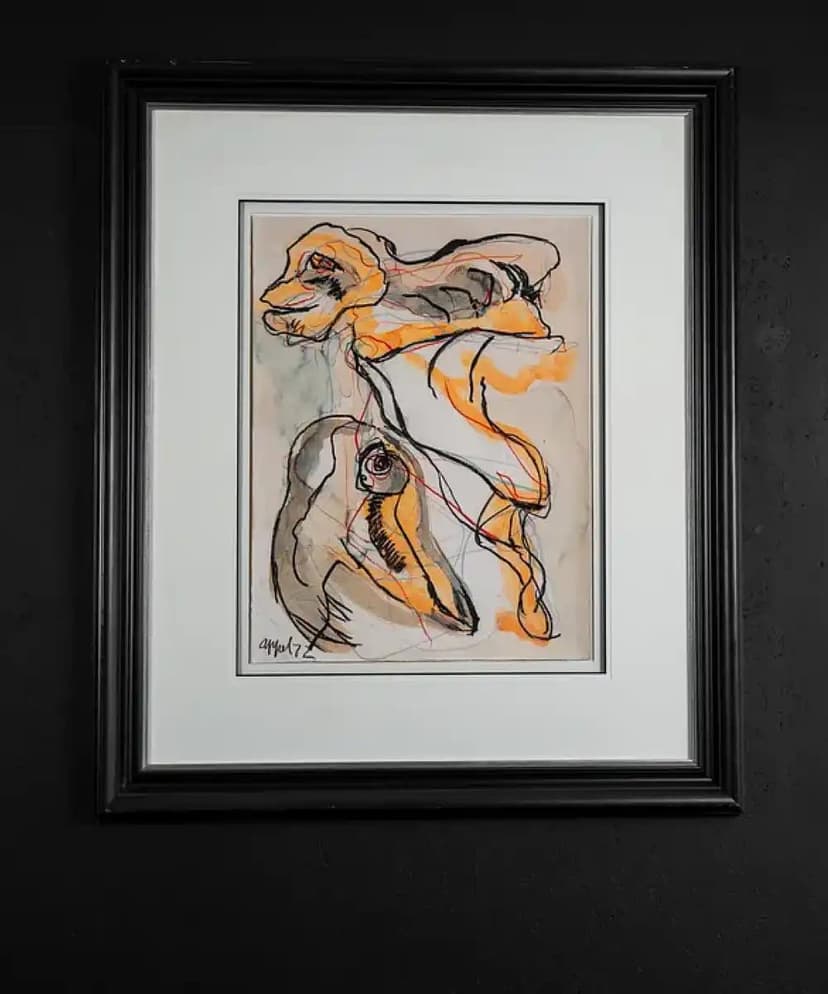
Man
Karel Appel was born in Amsterdam in 1921 into a working-class family where discipline and simplicity were the norm. Appel is impetuous, greedy, and loud. An artist who lives on intuition. He travels around the world and remains himself everywhere: unfiltered, intense, and human.
"I paint like a barbarian," he says, "because civilization bores me."
Moment
In 1948, Appel co-founded the COBRA movement, a group of artists from Copenhagen, Brussels, and Amsterdam who rejected the rationalism of post-war art. They found inspiration in children's drawings, folk art, and primitive forms, using these to express their credo of freedom, imagination, and spontaneity to the world. Appel became the face of that movement. After the COBRA years, he continued to follow his own path. His work became larger, louder, more intense, and more sculptural, more musical. He painted, drew, sculpted, wrote poetry, and sang with his hands.
Matter
Appel does not paint on the canvas, but in the canvas. His layers of paint are thick, pasty, and physical. Color becomes substance, like a living organism.
His red is warm, his blue sings, his yellow glows like sunlight in paint. Every stroke is a gesture, every stain an emotion. His sculptures follow the same principle. They are shapes that seem to dance, laugh, and breathe.
What is his greatest contribution to art history?
Karel Appel liberates painting from thinking. He rediscovers the primary gesture, the direct relationship between hand, color, and emotion. He shows that art does not have to be rational to be profound. His influence ranges from European expressionism to American action painting. He restores post-war art's zest for life.
Can we consider him a master?
Although born in the Netherlands, Appel worked for much of his life in Belgium and France. His spiritual affinity with the Flemish expressive tradition is clear. He shares with Permeke, Raveel, and Bogart the urge to feel the world physically.
Appel is a master of emotion: boundless, honest, and full of life. He belongs to the wider family of European masters who focus on the human experience.
A work by him in every household?
Yes, after all, a work by Appel carries the energy of life itself. His paintings convey warmth, strength, and freedom. They speak not to the mind, but to the heart.
An Appel in your home is like a window onto pure vitality: a reminder that art is not a luxury, but a form of breathing.
His work inspires you, every day anew.